Chapter 05

A life that outlived its years

He was known publicly for barely three months. He has been remembered for more than a hundred and fifteen years. This chapter is about the difference between those two facts.

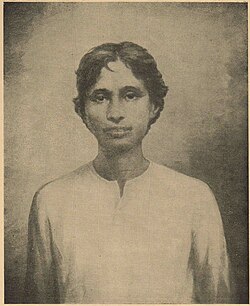
Painted portrait of Khudiram Bose by the artist Haripada Das, showing him in a light kurta against a plain ground.
Plate 04 · PaintingA painted portrait of Khudiram Bose by Haripada Das, held at Mahajati Sadan in Kolkata. Painted and displayed commemorations of this kind are a substantial part of how his image has been carried forward.

Memory in Bengal

How a name stayed in circulation

The memory of Khudiram Bose in Bengal did not begin with statues or state commemoration. It began in the weeks after August 1908, in forms the colonial administration had no practical way to prohibit.

The most frequently recorded example is the dhoti. Accounts of the period describe weavers producing cloth with his name worked into the border, worn openly by people who would not otherwise have declared a political position. Mourning gatherings, closed shops and memorial meetings were reported in Calcutta, in Midnapore and across the districts. None of this required an organisation, and none of it could be prosecuted as sedition without absurdity.

Midnapore, where he had been at school and where he was recruited, kept his memory particularly closely, and it is in that district and in Kolkata that most of the institutions bearing his name are found today.

Literature & culture

The song, and what it is not

The single most important vehicle of his memory is not a monument. It is a song that almost every Bengali child has heard.

Ekbar Biday De Ma Ghure Ashi

The Bengali song Ekbar Biday De Ma Ghure Ashi — ‘Bid me farewell once, Mother, let me go’ — was written by the poet Pitambar Das in commemoration of Khudiram Bose after his death. It is written in the first person, as though spoken by Khudiram to his mother before his execution.

This is the point at which most popular accounts go wrong, and it is worth being exact. The song is not a statement by Khudiram Bose. He did not write it, did not sing it, and never spoke its words. It is a work of literature composed about him, in his imagined voice, by someone else. Lines from it are nonetheless quoted constantly as though they were his own.

Its influence is genuine and considerable. It passed into Bengali popular music and has been recorded many times over the following century, including in a widely known recording by Lata Mangeshkar. For a great many people the song is the memory of Khudiram Bose, which is precisely why the distinction between the song and the man is worth preserving.

Attribution Words from Ekbar Biday De Ma Ghure Ashi are frequently presented online as the last words of Khudiram Bose. They are not. The song is the work of Pitambar Das, written after 1908. No verified record of Khudiram Bose’s own last words exists.

In poetry

The poet Kazi Nazrul Islam, whose work is central to the literature of Bengali nationalism, wrote commemorative verse invoking Khudiram Bose. He remained a recurring figure in the nationalist poetry and popular literature of the following decades.
Memory across India

Places and institutions that carry his name

The naming below is documented. Where an institution’s name has changed over time, the current name is given.

Khudiram Bose Pusa railway station

Waini railway station, where he was arrested on 1 May 1908, was subsequently renamed in his memory. The place of his capture is now the place that carries his name.

Samastipur district, Bihar

Khudiram Bose Memorial Central Jail

The central jail at Muzaffarpur, where he was held and executed, carries his name.

Muzaffarpur, Bihar

Shahid Khudiram metro station

A station on the Kolkata Metro named in his memory.

Kolkata, West Bengal

Shahid Khudiram Bose Hospital

A government hospital on B.T. Road named after him.

Kolkata, West Bengal

Sahid Khudiram Siksha Prangan

A campus of the University of Calcutta named in his memory.

Kolkata, West Bengal

Mahajati Sadan

The public hall in central Kolkata where the painted portrait of Khudiram Bose by Haripada Das, shown at the top of this page, is kept.

Kolkata, West Bengal
What is not listed here Statues, roads and schools bearing his name exist in many towns in West Bengal and Bihar. This archive lists only those it can name specifically. It does not invent memorials, books, films or songs in order to lengthen a page.

Interpretation

Why Khudiram Bose still matters

Youth

He was eighteen. The movement that sent him to Muzaffarpur recruited teenagers deliberately, for reasons that were organisationally rational and morally serious. Any honest account of the Bengal revolutionaries has to hold both of those facts at once.

01 · Age

Conviction

He acted on a political conviction that he did not disown at trial and did not abandon under sentence. That is why he was remembered. It is not, by itself, a judgement on whether the conviction was right.

02 · Belief

Consequence

Two women were killed who had no part in the quarrel. The intended target was unharmed. The organisation that planned the operation was broken within months. The gap between intention and outcome is the most instructive thing about the case.

03 · Result

The state’s response

The decision to hang an eighteen-year-old was lawful and, from the administration’s point of view, straightforward. It was also the decision that turned him into a permanent figure of Indian memory. Severity produced the opposite of what it intended.

04 · Power

How memory works

What Bengal remembered was not a tactical argument about political violence. It was a boy, a trial, and a morning in August. Public memory selects, and understanding what it selected tells us as much about 1908 as the court record does.

05 · Memory

Reading history honestly

Khudiram Bose can be taken seriously as a historical figure without his actions being endorsed, and his death can be treated as a tragedy without the deaths he caused being set aside. That is the standard this archive tries to hold to.

06 · Method

India’s independence, when it came in 1947, was won by a mass movement that had largely rejected the methods of the Bengal revolutionaries. Khudiram Bose is not remembered because his strategy succeeded. He is remembered because of what his case revealed — about a colonial administration prepared to hang a schoolboy, about a generation that had run out of patience with petitioning, and about the gap between what political violence intends and what it achieves.

That is a more difficult inheritance than a straightforward story of heroism, and it is a more useful one.

Continue: the image archive