Chapter 01
His Life
Khudiram Bose lived for eighteen years and eight months. Almost everything documented about him belongs to the last three of those years — which makes the first fifteen worth setting down carefully.
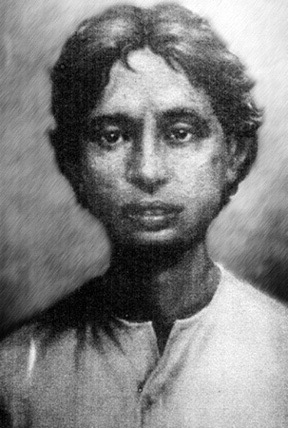
Early life
Born into a district, orphaned into a household
Khudiram Bose was born on 3 December 1889 in the Midnapore district of the Bengal Presidency, in a village most accounts name as Habibpur and some name as Mohobani. The locality lies in what is today Paschim Medinipur in West Bengal. His father was Trailokyanath Bose and his mother Lakshmipriya Devi; the family was of modest means, of the Bengali Kayastha community, and entirely unremarkable in the record of the period.
Both of his parents died while he was a small child — the standard accounts place the losses at around the ages of five and six. He was taken in and brought up by his elder sister, Aparupa Roy, and her husband Amritalal Roy. It was his brother-in-law who arranged his admission to Hamilton High School in Tamluk.
This is not a great deal of biography, and it is worth being honest about why. Khudiram Bose was not a public figure until the last months of his life. Nobody kept his letters, recorded his conversation or documented his schooling as it happened. What survives about his childhood was written down afterwards, largely by people reconstructing the early years of someone who had by then become famous. Where this archive states a fact about his childhood, it states one that the principal accounts agree upon.
Education and the district town
Midnapore in the early 1900s was not a backwater. It was a district headquarters with schools, printing presses, reading rooms and an unusually dense network of student associations. Boys attending its schools had access to nationalist newspapers, to lecture meetings, and to the akharas and gymnasiums that combined physical training with political discussion. Khudiram Bose was educated in this environment, first at Tamluk and later in Midnapore town.
His formal education was not completed. By the time he was sixteen he had committed himself to political work, and school records cease to be the useful source for his life.
At a glance
Khudiram Bose
- Full name
- Khudiram Bose (also transliterated Khudiram Basu)
- Born
- 3 December 1889, Habibpur (also given as Mohobani), Midnapore district, Bengal Presidency
- Father
- Trailokyanath Bose
- Mother
- Lakshmipriya Devi
- Guardians
- Elder sister Aparupa Roy and her husband Amritalal Roy
- Schooling
- Hamilton High School, Tamluk; later at Midnapore. Not completed.
- Affiliation
- Anushilan Samiti and the revolutionary circles of Midnapore
- Died
- 11 August 1908, Muzaffarpur, aged 18 years 8 months
The setting
A province was divided, and a generation of students discovered politics.
Historical Bengal
Bengal at the turn of the twentieth century was the administrative and intellectual centre of British India. Calcutta was the imperial capital until 1911. The province had the country’s oldest modern universities, its most developed press, and a large, educated, professional middle class that had spent half a century arguing with the colonial state in its own language and on its own terms.
The Partition of Bengal
In 1905 the Viceroy, Lord Curzon, announced the division of the Bengal Presidency into two provinces. The measure took effect on 16 October 1905. The administration presented it as a practical response to the difficulty of governing an enormous province. It was received across Bengal as something else entirely: a calculated attempt to split Bengali political society and dilute its influence.
The reaction was immediate and far larger than the government had anticipated. Public meetings, processions and the ritual tying of rakhi threads as a symbol of unbroken Bengal marked the day the partition came into force.
The Swadeshi and Boycott movements
Out of the protest came the Swadeshi movement — a campaign to boycott British manufactured goods and to promote Indian production, Indian schools and Indian institutions. Its practical achievements were uneven, but its effect on political participation was enormous. For the first time, large numbers of students and schoolboys became active participants in a mass political campaign rather than spectators to a debate conducted by their elders.
Repression and the turn to secret societies
The colonial administration responded with prosecutions of nationalist editors, restrictions on public meetings, and disciplinary action against students who took part. That response had a radicalising effect. A section of the movement concluded that constitutional agitation had been tried and had failed, and that organised secret societies were the only remaining instrument. The Anushilan Samiti, founded in Calcutta at the beginning of the century, expanded rapidly across the districts. The journal Jugantar gave the argument a public voice until its editors were prosecuted.
Khudiram Bose turned sixteen in the year the partition took effect. His political education and the province’s political crisis happened at the same moment.
Formation
A young mind in a changing India
Popular accounts of Khudiram Bose often describe his inner life in confident detail — what he felt as a child, what he resolved, what he vowed. Almost none of it is documented. He left no diary, no memoir and no substantial body of writing. Claims about his private motivations are, with few exceptions, later reconstruction.
What can be said rests on evidence. He was recruited into the Anushilan Samiti in Midnapore, in a district where such recruitment among students was common and organised. Accounts of the period credit Hemchandra Kanungo with drawing him in, and record that visits to Midnapore by Sri Aurobindo and by Sister Nivedita made a strong impression on the town’s young political circles. In 1906, at sixteen, he was arrested for distributing the nationalist pamphlet Sonar Bangla; he was defended by the barrister Birendranath Sasmal and released. Two years later he was in Muzaffarpur.
That sequence is the evidence. It shows a boy moving from the outer edge of a political movement to its most dangerous inner work within roughly three years — a trajectory that was not unusual in Bengal at the time, and which the revolutionary societies actively cultivated among the young.
Why the movement recruited the young
The revolutionary societies of Bengal recruited from schools and colleges deliberately and for practical reasons. Students had time, mobility and networks; they were less likely to be under surveillance; they had fewer dependants; and they could be organised through the gymnasium and study-circle structures that already existed in every district town.
The consequences of that recruitment strategy fell on people who were, by any modern standard, children. Khudiram Bose was sixteen at his first arrest and eighteen when he was hanged. Prafulla Chaki, who acted with him at Muzaffarpur, was about nineteen when he died. This is a fact about the movement as much as about the individuals in it, and it is part of what makes the history difficult rather than simple.
Chronology of a life
Fifteen quiet years, three documented ones
Birth
Born 3 December in Midnapore district, Bengal Presidency.
Orphaned
The deaths of Trailokyanath Bose and Lakshmipriya Devi. The boy is raised by his elder sister Aparupa Roy and her husband.
Schooling
Admitted to Hamilton High School, Tamluk; later associated with Midnapore town, where the district’s political societies were most active.
Partition
The division of Bengal takes effect on 16 October. The Swadeshi and Boycott movements follow.
Recruitment
Drawn into the Anushilan Samiti and the revolutionary circles of Midnapore.
First arrest
Detained at Midnapore for distributing Sonar Bangla. Defended by Birendranath Sasmal and released.
Muzaffarpur
The events of April, the trial in May and June, and the execution on 11 August.